
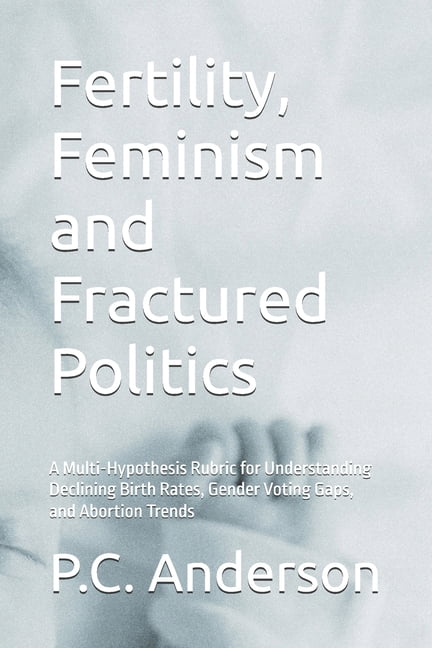
Fertility, Feminism and Fractured Politics: A Multi-Hypothesis Rubric for Understanding Declining Birth Rates, Gender Vo, (Paperback)
Product details
| Management number | 238706724 | Release Date | 2026/07/11 | List Price | US$4.78 | Model Number | 238706724 | ||
|---|---|---|---|---|---|---|---|---|---|
| Category | |||||||||
<p>Birth rates are collapsing. Gender politics are polarizing. Abortion remains fiercely contested. And beneath these headlines lies one of the most consequential demographic transformations in modern history. <i>Fertility, Feminism and Fractured Politics</i> offers a rare kind of clarity: a rigorous, transparent framework for understanding <b>why</b> these shifts are happening-and what they mean for the future of families, economies, and democratic societies.</p><p>Rather than blaming a single cause, the book evaluates <b>eight competing explanations</b> for declining fertility and widening gender divides: ideological change, economic pressures, education and opportunity, reproductive technology, institutional trust, male-female value divergence, digital culture, and policy incentives. Each hypothesis is tested against the strongest available evidence from CDC data, Pew surveys, Guttmacher abortion estimates, OECD policy comparisons, and county-level political patterns.</p><p>Readers will learn: </p><ul><li><p>Why U.S. fertility has fallen to record lows (general fertility rate 53.1 in 2025) even as desired family size remains higher.</p></li><li><p>Why conservative counties and religious communities maintain significantly higher birth rates than progressive, secular, or high-cost urban areas.</p></li><li><p>How housing costs, childcare prices, and economic insecurity interact with cultural norms to shape family decisions.</p></li><li><p>Why post-Dobbs abortion numbers remained stable ( 1.126 million in 2025) despite state restrictions, and what this reveals about demand, telehealth, and adaptation.</p></li><li><p>How social media and digital culture accelerated ideological divergence among young women after 2010.</p></li><li><p>Why no single explanation-economic, cultural, or technological-can fully account for the patterns we observe.</p></li></ul><p>At the heart of the book is a <b>14-dimension scoring rubric</b> that evaluates each hypothesis on explanatory scope, predictive power, empirical support, falsifiability, subgroup robustness, policy sensitivity, and more. The result is a clear ranking of which forces matter most-and how they interact. Economic constraints emerge as the strongest overall driver, but ideology, religiosity, and policy design remain indispensable parts of the causal network.</p><p>The book goes further, offering: </p><ul><li><p><b>Causal diagrams and interaction models</b> showing how economics, culture, and technology reinforce one another.</p></li><li><p><b>Bayesian updating</b> that transparently revises the weight of each hypothesis as new evidence arrives.</p></li><li><p><b>Scenario projections</b> for the future of fertility under different economic, cultural, and policy conditions.</p></li><li><p><b>Policy implications</b> grounded in real-world experiments from the Nordics, Hungary, East Asia, and U.S. states.</p></li><li><p>A candid discussion of <b>limitations, data gaps, and unresolved debates&l</b></p></li></ul>
- Fertility, Feminism and Fractured Politics: A Multi-Hypothesis Rubric for Understanding Declining Birth Rates, Gender Vo, (Paperback)
- Author: Independently Published
- ISBN: 9798258794109
- Format: Paperback
- Publication Date: 2026-04-25
- Page Count: 62
| Book format | Paperback |
|---|---|
| Fiction/nonfiction | Non-Fiction |
| Genre | Political & Social Sciences |
| Publication date | April, 2026 |
| Pages | 62 |
| Subgenre | Abortion & Birth Control |
| Series title | No Series |
| Number in series | 0 |
| Edition | 1 |
| Publisher | Amazon Digital Services LLC - Kdp |
| Original languages | English |
| Language | English |
| Is collectible | N |
| Recording time | 0 min |
| Retail packaging | Single Piece |
| Assembled product dimensions (l x w x h) | 6.00 x 0.13 x 9.00 in |
| Assembled product weight | 0.21 lb |
| Bisac subject heading | Social Science |
Bestseller ranking
All Books






Customers who viewed this product also viewed
Theosophy Books






Correction of product information
If you notice any omissions or errors in the product information on this page, please use the correction request form below.
Correction Request Form